-
-
Crete is a beautiful Greek island known for its stunning beaches, rich history, excellent cuisine, and exclusive olive oil. Although driving on the island can be an adventure in itself, I believe that traveling by car is the best way (right after hiking) to explore this island. Here's a small guide for those who want to discover Crete this way.
What you should know (some basic rules)
Driving vehicles on Crete
Renting a vehicle
Vehicle insurance
Fueling and gas stations
Parking
Fines and penalties
Traveling with children
Navigation
Categorization of traffic routes
-
-
Travel (by car)
Driving a car in Greece and Crete is an ideal way to explore the beauty of the country, beaches, mountains, traditional mountain villages, and ancient monuments. If you plan to rent a car or bring your own vehicle, it's important to prepare a little since driving in Greece has its specifics and may differ from driving in the Czech Republic, Slovakia or Poland.
What you should know
In Crete (and Greece), driving is on the right. So, just like in the Czech Republic or Slovakia, you drive on the right side of the road.
The use of seat belts is mandatory for all passengers in the vehicle.
The allowed blood alcohol content while driving is 50 mg per 100 ml of blood (0.05%, which corresponds to consuming two beers). I would definitely recommend not drinking at all while driving.
Daytime running lights are not permitted in Greece, including Crete (except when passing through tunnels).
Speed limits are indicated by round signs with a red border and a number (km/h). Always follow these signs (or check the Waze navigation app, where you'll find the current speed limit). City areas 30-50 km/h, hotel areas (along main roads) usually 60 km/h, main roads up to 90, and highways max. 110 km/h.
Mandatory equipment - reflective warning triangle, fire extinguisher, first aid kit.
In some cases, rental companies may not have this equipment in their cars. In case of problems, the rental companies should take responsibility for it.
The use of mobile phones while driving is prohibited (unless you have a hands-free device).
Beware of roundabouts. There are essentially two types: those that we know from Central Europe and those where the vehicle entering the roundabout has priority. You must deduce which type of roundabout it is based on the signage (e.g., a stop sign at the roundabout entry).
There are no toll roads on Crete (unlike mainland Greece). There are no highway stickers or tolls either.
In case of accidents or emergencies, call the European emergency number 112. Direct Greek emergency numbers are as follows: 100 - Police, 166 - Ambulance, and 199 - Fire Department. Don't forget to also contact the rental company or your tour guide.
Respect all traffic signs, signals, and road markings. Pay attention to specific rules and regulations, especially in urban areas.
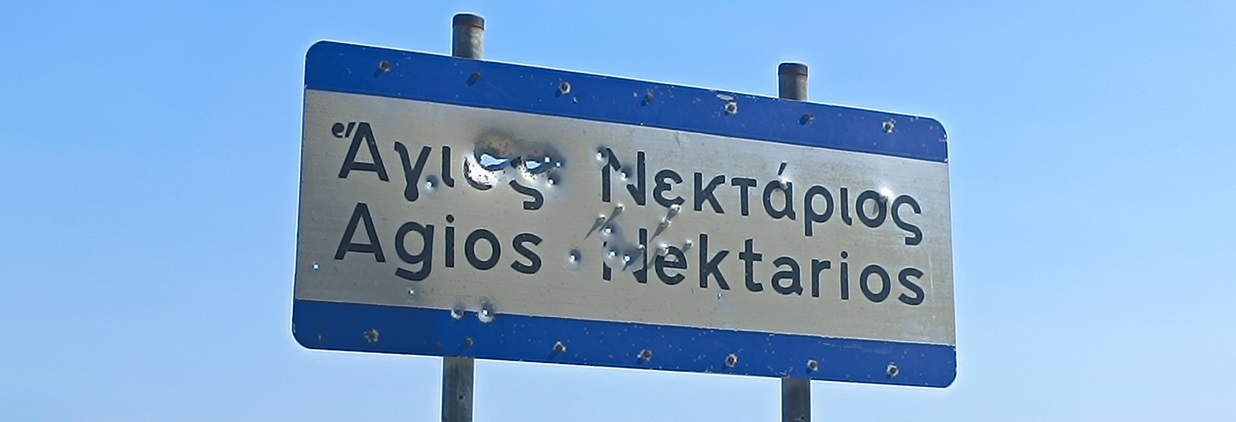
City names are written in both the Greek and Latin alphabets.
Follow parking regulations to avoid fines (see below "Parking").
If you drive a motorcycle, the driver and passenger must wear helmets.
Driving Vehicles on Crete
To legally drive in Greece, you must be over 18 years old and hold a valid driver’s license. Motorcycle drivers (up to 125 cc) must be over 18 years old, and moped drivers (up to 50 cc) must be over 16 years old. You should also carry another ID (passport or national ID card) along with your driver’s license.
Driver’s licenses issued in EU and EEA countries are accepted. International driver’s licenses are recognized but not required.
The minimum age for renting a car is 21 years, although this may vary depending on the type of vehicle (rental agencies sometimes make exceptions). In Greece, you can usually work something out.
Rental companies (mostly) require that you have held a driver’s license for at least 1 year.
Instead of a technical certificate, rental companies will provide you with a rental agreement (paper or digital), which you must present in case of an inspection.
Renting a Vehicle
A car can be easily rented online, directly on Crete, or by contacting me, and I will arrange it for you. Do you need the car delivered to the airport or hotel? Let me know. If you arrived on Crete with a tour operator, I recommend booking a car with your guide. Travel agencies have long-term agreements with rental companies and can assist you in difficult situations. Keep in mind that NOT all rental companies have the same terms! When you pick up your car at the rental office or when an employee brings it to your hotel, don’t forget the following:
Take a photo of the car when you pick it up (or record a video on your smartphone).
Check the condition of the underside of the car, the tires, and the windshield for damage.
Before driving off, check if the car has a full tank of gas (in some cases, rental companies will offer you a full tank upon pick-up and expect it to be returned empty. If you don’t want to fill up the car, ask the rental company to top it up for you).
Make sure the car is properly insured (you can do this when you pick it up). I recommend adding collision damage waiver (CDW) insurance to avoid any future issues. If you choose an upgrade, read the terms carefully (some rental companies only offer you the CDW without taking care of the basic insurance).
Ask for a road map or have a GPS device available for your trip (the rental agency may or may not offer one).
Take the phone number of the rental company, tour guide, or your hotel so that you can contact someone in case of an emergency.
Don’t forget to check the trunk and storage compartments of the vehicle. If you’re using GPS, check if the device works properly, or use your own navigation app. Otherwise, buy a map and keep it with you.
Keep in mind that rental vehicles are rarely new cars. In some cases, the car may be quite old (usually a few years old, but you can occasionally come across a vehicle with a higher mileage). This is no cause for concern, but always check the car’s condition before driving off.
The rental office is generally not responsible for personal items left in the car (use the car’s safe compartments to store valuables).
After you drop off the car, check it for any new damage before you leave.
Vehicle Insurance
Most rental companies offer you basic car insurance. The basic insurance usually includes damage to the vehicle (excluding glass damage), third-party liability, and fire protection. In case of an accident, you must always report the incident to the local police. However, I recommend opting for an additional Collision Damage Waiver (CDW) insurance. CDW is a type of vehicle insurance that typically covers damages to the rental vehicle. It’s often included in the rental price but may have a deductible (excess). Always double-check with the rental company about what’s covered under the insurance policy.
Another important consideration is Third-Party Liability Insurance (TPL), which covers you in case you damage another vehicle or property. Always read the terms and conditions of the insurance carefully and ask the rental agency if there are any exclusions or restrictions.
If you plan on driving on mountainous terrain or on roads with rough conditions, you might want to add additional coverage for off-road damage or theft, as these are often excluded from standard policies.
Finally, make sure to check if the insurance covers accidents caused by a third party or by theft. It’s important to be aware of any additional costs or fees associated with insurance upgrades, so ask the rental company to explain the policy in detail before signing the rental agreement.
Fueling and Gas Stations
Crete has a well-developed network of gas stations, and you should have no problem finding one during your travels. Most gas stations on Crete operate from 7 AM to 9 PM, but some may remain open later in the summer season. You can find fuel stations along major roads and in cities, as well as near tourist resorts.
When filling up the tank, be sure to check the fuel type: most vehicles on Crete run on unleaded gasoline (benzine) or diesel, so make sure to fuel your car correctly. If you are driving a rental car, check the fuel type before you fill up.
When you rent a vehicle, it’s a good idea to return it with the same amount of fuel it had when you picked it up to avoid extra charges. Some rental agencies offer fuel options where they fill up the tank for you, but you’ll pay a premium price for the service.
If you find that the fuel tank is not full when you pick up the car, report this to the rental company and ask them to fill it up. Many rental agencies expect you to return the car with an empty tank if they offer you a full tank at the start of the rental.
Fuel prices can vary from station to station, and it’s always a good idea to check prices before filling up. Crete has a mix of local and chain gas stations, but the local stations are often more affordable.
Many gas stations accept major credit cards, so you shouldn’t have an issue paying. However, it’s always a good idea to carry some cash just in case.
Parking in Crete
Parking in larger cities (Heraklion, Chania, Rethymno) can be a challenge. Try to look for parking options before you arrive in the city, so you don't waste precious time searching. Especially in the hot summer months, it can be uncomfortable and time-consuming.
Recommended parking spots in larger cities:
Chania: Talos Square or on the other (eastern) side of the harbor near the "Theatro Anatolikis Tafrou" theater.
Rethymno: at the marina (Marina of Rethymno), about 500 meters east of the promenade.
Heraklion: Heraklion Marina Cafe Parking next to the harbor, or any paid parking in the city center. Sometimes I also try around the KTEL bus station, and it almost always works (a little below the Archaeological Museum).
Parking at larger or famous beaches (Elafonissi, Falasarna, Preveli, etc.) can also be more difficult due to the high influx of tourists (during peak season). Therefore, it's better to arrive at these places early. I recommend having an early breakfast and leaving as early as possible. Most beaches have paid parking lots (around 5 EUR/day), and some even offer free parking.
Fines and Penalties in Greece
On-the-spot fines - The Greek police cannot collect fines from drivers on the spot.
Minimum and maximum fines - range from 40 EUR for minor speeding violations to 1,200 EUR for driving under the influence of alcohol. Some traffic violations are considered criminal offenses and can lead to the confiscation of the driver's license, vehicle, and even imprisonment.
Cross-border enforcement directive - If you commit a traffic offense in Greece or another EU country, this offense could theoretically follow you back home to the Czech Republic or Slovakia, where you might still be prosecuted. However, this directive has not been fully implemented by the EU, and some countries have not agreed on its final version.
Fines for improper parking: Pay attention to parking restrictions (even though locals park just about everywhere). A fine for improper parking can be up to 80 EUR.
Fines for speeding in Greece range from 40 EUR to 750 EUR, depending on the speed at which the driver was caught and the road they were driving on.
Be aware that speed is measured both by traffic police and automatic cameras/photo traps scattered along Crete's roads.
Traveling with Children
If you're traveling with a child under 4 years old, don't forget to bring a child seat. Children under 10 years old are not allowed to sit in the front passenger seat. Children aged 3 to 11 must be seated in a child seat appropriate for their age/size. From the age of 12, children taller than 135 cm can be secured with an adult seatbelt.
Navigation
Google Maps, Waze or Mapy.cz? It doesn't really matter which app you choose, but it's good to use one of them while traveling. I most often use Mapy.cz (also in offline mode - in cases when the signal drops), which are probably the most accurate. For main roads, I use Waze, which provides real-time traffic updates, including police locations and other road information. However, it’s not 100% reliable.
Traffic Route Categorization
In our articles, we sometimes refer to the traffic route category (roads) that we've divided according to the Greek guide for motorists into 8 categories based on their condition (quality). These include 4 categories of paved roads (A1, A2, A3, A4) and 4 categories of unpaved roads (X1, X2, X3, X4).
A1: European-type highway (yes, such roads exist in Greece!) with two or three lanes in one direction and a divider between directions.
A2: Wide main road with one or two lanes in each direction, guardrails at dangerous spots, and good signage.
A3: Typical Greek regional road with small cute bumps, potholes, surprises, and smooth shiny asphalt.
A4: Asphalt road of catastrophic level! Very narrow, full of potholes, broken shoulders, and left uncared for with no maintenance.
Cars rented from Crete’s rental agencies are not insured for the roads listed below (X1 - X4). I recommend avoiding unpaved roads (e.g., the road to Balos Lagoon, which is closed to passenger vehicles from spring 2024).
X1: Very good dirt road. All types of vehicles, even buses, can pass through without any problems. Even a Jawa 500!
X2: Good dirt road with small imperfections. All vehicles pass relatively comfortably.
X3: Typical Greek dirt road. Requires cautious driving to avoid potholes and unevenness. Jeeps and off-road motorcycles can easily pass.
X4: Dusty catastrophic road! With large potholes, ravines, puddles, landslides, mud, and steep slopes. Only light off-road motorcycles and true off-road vehicles can pass through.

 English
 Čeština
 Polski
 Slovenčina
 Українська